


Most discovery workshops end in agreement. Far fewer end in sign-off that survives the first sprint review. The gap rarely shows on the day. It shows eight weeks into the build, when a director who nodded along asks why the thing on screen doesn’t do what they assumed it would.
A discovery workshop is a structured session, or a short series of sessions, where the people who fund, run and use a product agree what problem it solves, who it’s for and what gets built first. Done well, a discovery workshop produces a decision record people can be held to. Done badly, it produces a slide deck everyone reads differently.
This guide is for enterprise product owners, heads of digital and programme leads who have run discovery before and watched the agreement come apart. It covers who to invite, how to handle conflicting priorities, what the output should look like, and how to keep alignment intact once the build starts.
Why stakeholder sign-off unravels
Sign-off rarely fails because people disagree. It fails because people agreed to different things. A workshop that closes on “we’re aligned on a self-service portal for account managers” has agreed a phrase, not a scope. Finance hears lower cost to serve, operations hears fewer support tickets, and the head of account management hears a new reporting dashboard.
The pattern is common enough to show up in the industry data. PMI’s Pulse of the Profession research on scope creep found that 52% of projects completed in the previous 12 months experienced scope creep or uncontrolled changes, up from 43% five years earlier. Changing priorities and poorly gathered requirements sit behind most of it. In product work, both usually trace back to a discovery that produced consensus without commitment.
So the fix isn’t a longer workshop. It’s getting the right people in the room, settling disagreement with evidence rather than seniority, and writing the output so it can be checked against later.
Who to invite to a discovery workshop
Invite for decision rights, not job titles. For every name on the list, ask one question: what could this person block later if they aren’t here now?
| Role | Why they need to be in the room | What happens without them |
|---|---|---|
| Sponsor (holds the budget) | Breaks ties and signs off scope | The workshop produces recommendations nobody can approve |
| Product owner | Owns the backlog day to day | Decisions get quietly reinterpreted at sprint level |
| Operational lead for the team that will use it | Knows how the work really happens | The product is designed around the process on paper |
| Your technical lead or architect | Integration, hosting and legacy constraints | Scope is agreed that can’t be built in your stack |
| Security, data or compliance | Data handling, AI use, regulatory limits | A late veto, often after design is finished |
| Agency design and engineering leads | Turn decisions into options and cost them | Nobody tests whether what’s agreed is feasible |
Keep the core group to between six and ten people. Above that, people stop debating and start performing for the room. The GOV.UK Service Manual’s guidance on setting up a service team is a useful cross-check on the skills a discovery needs, even outside government.
The person most often missing is the one with veto power who doesn’t see themselves as a stakeholder. That’s usually information security, procurement, or the head of a team whose process will change. If they can stop the work later, give them a seat now, even if it’s only for one session.
Watch for the sponsor who delegates to a deputy without authority to decide. At a minimum, the sponsor attends the opening session and the final decision session. If they won’t, that tells you something about how the build will go.
Do end users belong in the workshop?
Usually not in the decision sessions, but their evidence does. Interviews and observation should happen before the workshop, so the room debates what users actually do rather than what stakeholders believe they do. That research is the core of product discovery and rapid prototyping, and it’s what stops the loudest voice setting the requirements.
Do the groundwork before anyone books a room
Workshops go wrong when they’re used to uncover facts someone could have found in a week. Before the first session, run short one-to-one interviews with every stakeholder. People say things privately they won’t say in front of their director, and you want the disagreements surfaced before they’re voiced in public.
Alongside those interviews, observe the people who live with the problem and record a baseline: how long tasks take, where errors happen, what workarounds exist. That baseline is what every later claim of value gets measured against. It’s also the most direct way to answer the question in our guide on how to validate an enterprise product idea before money is committed.
The Benchmark carbon estimating case study shows why this matters. Vigo came in after a poorly received alpha. Rather than reopening the debate about features, the team ran observation sessions with estimating engineers, and what they saw shaped dense, high-contrast data tables and background processing for large tasks. Observation replaced opinion, which is far easier to sign off.
How to handle conflicting stakeholder priorities
Conflicting priorities are normal in enterprise work. Hidden ones are the problem. The aim of the workshop isn’t to make everyone happy; it’s to make every trade-off visible and owned.
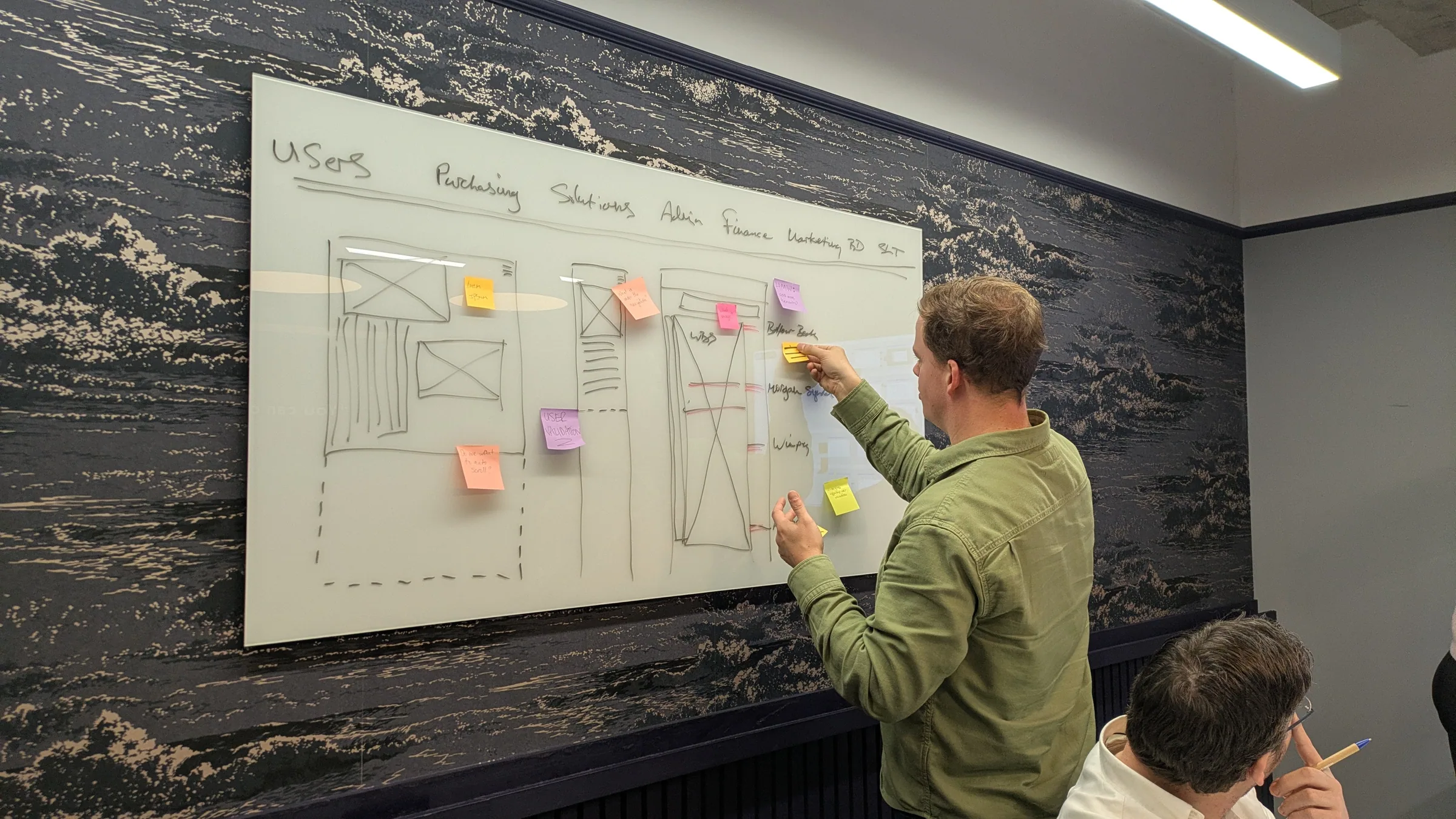
Put the conflicts on the wall
Take what each stakeholder told you in the one-to-ones and lay their priorities side by side against the draft problem statement. A surprising number of “conflicts” turn out to be the same goal at different stages. Cost reduction and better service often depend on the same fix, done in a different order.
Agree the decision rule before the decision
Before anyone debates features, agree how you’ll decide. For example: “We prioritise whatever cuts time on task for the operations team, inside the security constraints, and the sponsor settles ties.” Once the rule is agreed, the argument moves from rank to evidence, and stakeholders who lose a point can see why.
Be wary of MoSCoW in enterprise rooms. Everything drifts into “must have” because nobody wants their item demoted in front of colleagues. Force-ranking against the decision rule, or giving each stakeholder a fixed budget of points to spend, makes the cost of each choice visible.
Test what can be tested
If two stakeholders disagree about what users need, that’s a research question, not a debate. Build two concepts as clickable prototypes and test them head to head with real users. The guide to user-driven design and usability testing covers how to run that well.
Evidence informs the decision; it doesn’t make it. In the Catchbox e-commerce redesign, the client tested concepts head to head and then chose the one users didn’t favour, for sound commercial reasons. That’s a healthy outcome. The trade-off was made knowingly, by the person entitled to make it, and written down.
Park ideas, don’t bury them
Keep a “not now” list with an owner and a review date for each item. Stakeholders accept losing a point far more readily when it’s recorded with a date than when it simply disappears. Revisit the list at each phase gate so it never becomes a graveyard.
What the output of a discovery workshop should look like
The output is a decision record, not a deck. It should be short enough to read in 15 minutes and specific enough that someone joining the project in month three can tell what was agreed and why.
| Section | What it contains | Who signs it |
|---|---|---|
| Problem and success measures | The problem in one paragraph, the measures of success and the baseline figures | Sponsor |
| Users and journeys in scope | Who the first release serves and the core tasks it supports | Product owner and operational lead |
| Scope and out of scope | What the first release includes, and an explicit list of what it doesn’t | Sponsor |
| Decision log | Each decision, who made it, the evidence behind it and the trade-off accepted | Everyone in the core group |
| Constraints | Technical, data, security and regulatory limits | Technical lead and security |
| Risks and assumptions | What still needs testing, with an owner for each | Product owner |
| Options and costs | Two or three delivery options with time and budget ranges | Sponsor and finance |
The out-of-scope list does more work than any other part of the document. It’s what you’ll point to in week ten when someone asks why a feature isn’t there. For budget ranges at each stage, our guide to enterprise MVP agency pricing breaks down what moves the number.
Get sign-off in writing from each named person, not a show of hands in the room. An email or a comment on the shared document is enough. What matters is that each person has read the record and confirmed it, on a date you can point back to.
How to stop alignment unravelling mid-build
Agreement decays. People forget the reasons behind a decision long before they forget the decision itself, and that’s when they start relitigating it. These habits keep the record alive.
Run every change request through the decision log
When a request contradicts a logged decision, it goes back to the person who made that decision, with the original evidence attached. Most requests either fall away at that point or get approved properly, with the trade-off recorded.
Price every change
Never answer a new request with “yes” or “no”. Answer with what it costs and what it displaces. A stakeholder who wants a new report should see that it pushes the approvals workflow back by two sprints. Then the sponsor decides, using the rule everyone agreed in the workshop.
Show real screens early
Alignment usually starts to slip the first time stakeholders see something real, because that’s when their private picture meets the actual product. The earlier that happens, the cheaper the correction. Clickable prototypes in discovery, followed by fortnightly demos of working software, keep those moments small.
Re-check alignment at each phase gate
At each handover, from prototype to build and from build to rollout, run a 90-minute session against the original success measures. Is the evidence still pointing the same way? Has anything in the organisation changed? The phases in our guide to enterprise customer portal redesign show where those gates typically fall.
Watch for the AI-built prototype
A newer way for scope to unravel: someone in the business builds a prototype with an AI coding tool mid-build. It looks finished, it does something the agreed scope doesn’t, and suddenly the decision log is up for debate. Treat it as evidence for the next discovery cycle, not a replacement for the build. Taking an AI-built prototype to production safely is a separate piece of work with its own scoping.
The same caution applies inside the workshop. If you use AI to synthesise interview transcripts or workshop notes, those notes often contain customer data and commercially sensitive detail. Our guide to using AI in product development without exposing your code or data covers how to do that inside your own environment.
Discovery workshop questions people often ask
How long should a discovery workshop be?
Typically two or three half-day sessions inside a discovery phase of two to four weeks. Full-day sessions lose energy after lunch, and spacing the sessions gives time to test assumptions between them.
How many people should attend?
Six to ten in the core decision group. Specialists can join for the single session that needs them rather than sitting through all of it.
Who should facilitate?
Someone with no stake in the outcome. An internal facilitator who reports to one of the stakeholders will struggle to challenge them, which is one reason enterprises bring in an outside team for discovery.
What’s the difference between a discovery workshop and a kick-off?
A kick-off assumes the scope is settled and plans delivery. A discovery workshop decides what the scope should be. Running a kick-off when you need discovery is one of the most common reasons digital transformations fail.
Getting the room right
The moment a build goes wrong is rarely the moment the problem started. It started in a workshop where the wrong people were missing, a disagreement went unspoken, or the output left room for everyone to read it their own way.
If you have a discovery coming up, or a build where agreement is already starting to slip, book a scoping call with Vigo. We’ll look at who needs to be in the room and what the output needs to hold before the first session goes in the diary.